Home / BeaverDeck / Docs / User Guide / Purpose
Purpose
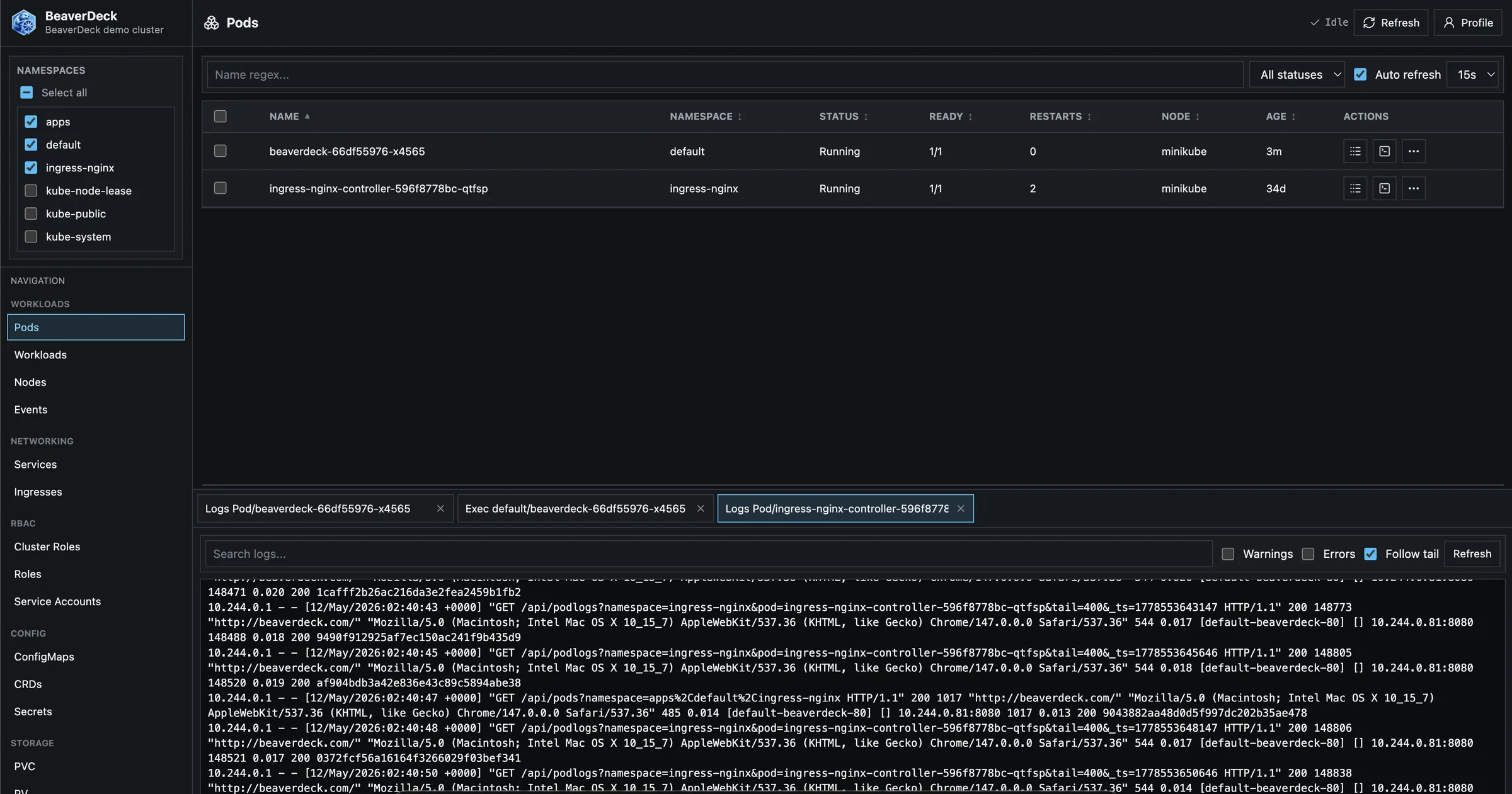
BeaverDeck is a Kubernetes operations workspace for inspecting cluster state, triaging incidents, planning capacity, and running common day-2 actions from a web UI. It brings resource state, Insights, manifests, logs, exec sessions, and controlled operations into one workflow so operators can move from a symptom to the affected object and an informed action without switching between separate tools.
Inspect, Triage, and Plan
- Inspect current state: browse nodes, pods, workloads, networking, storage, RBAC objects, configuration, events, and their manifests.
- Triage faster: start from grouped Insights, then open the related resource, logs, or manifest to confirm the cause before taking action.
- Find configuration gaps: surface missing resource requests, overrequested workloads, broken Secret or ConfigMap references, unsafe literal credentials, missing NetworkPolicy coverage, storage pressure, and networking problems.
- Plan capacity: compare workload requests with available node capacity, identify underused nodes and overprovisioned workloads, and review storage, quota, and GPU signals before scaling infrastructure or changing placement.
- Reduce avoidable errors: use passing and failing checks as a review layer that highlights risks before they become incidents or are repeated in future deployments.
Use Scarce GPU Capacity Deliberately
GPU capacity is currently scarce and expensive for many teams, while AI workloads can reserve it without making efficient use of the available devices. GPU Insights show discovered GPU capacity, allocation pressure, pending GPU pods, GPU node workload placement, quota signals, and whether GPU metrics are available.
These signals help teams decide whether to adjust requests or quotas, move workloads, improve observability, or add capacity. BeaverDeck does not replace the Kubernetes scheduler or automatically optimize placement; it provides the operational context needed to use GPUs more intentionally.
Access Remains Controlled
BeaverDeck does not replace Kubernetes RBAC. Every action still depends on both BeaverDeck role permissions and the Kubernetes permissions granted to the BeaverDeck ServiceAccount.